
Cracking the Code — A Technologist Tunes
On Fidelity, Systems, and the Shape of Work


Every voice at the table watches something different.
Some attend to meaning.
Some attend to form.
The Technologist attends to transmission.
His lens is neither expressive nor interpretive. It is operational. He watches ideas at their most vulnerable moment — when they leave the mind and attempt to survive contact with the world. He is less interested in what something means than in whether it arrives intact, able to act without distortion.
Where others ask what does this mean?,
the Technologist asks did it arrive?
Over the past several days, watching Brian Arrowood work, that lens kept narrowing on the same territory: the space between intention and outcome.
The first signal appeared in something ordinary. Final Cut Pro insisted on verifying audio units at every startup — a verification loop that consumed time without altering state, adding latency without increasing reliability. Many people would tolerate it. Some would complain. Brian did neither.
He wrote a script.
Not to extend capability, but to remove unnecessary repetition. A precise instruction: move specific components into a disabled folder before launch, then restore them afterward. The script did not remain abstract. It was bound directly to the Elgato Stream Deck — one button to enter Final Cut Pro cleanly, another to exit. No menus. No negotiation. The system was taught how to behave.
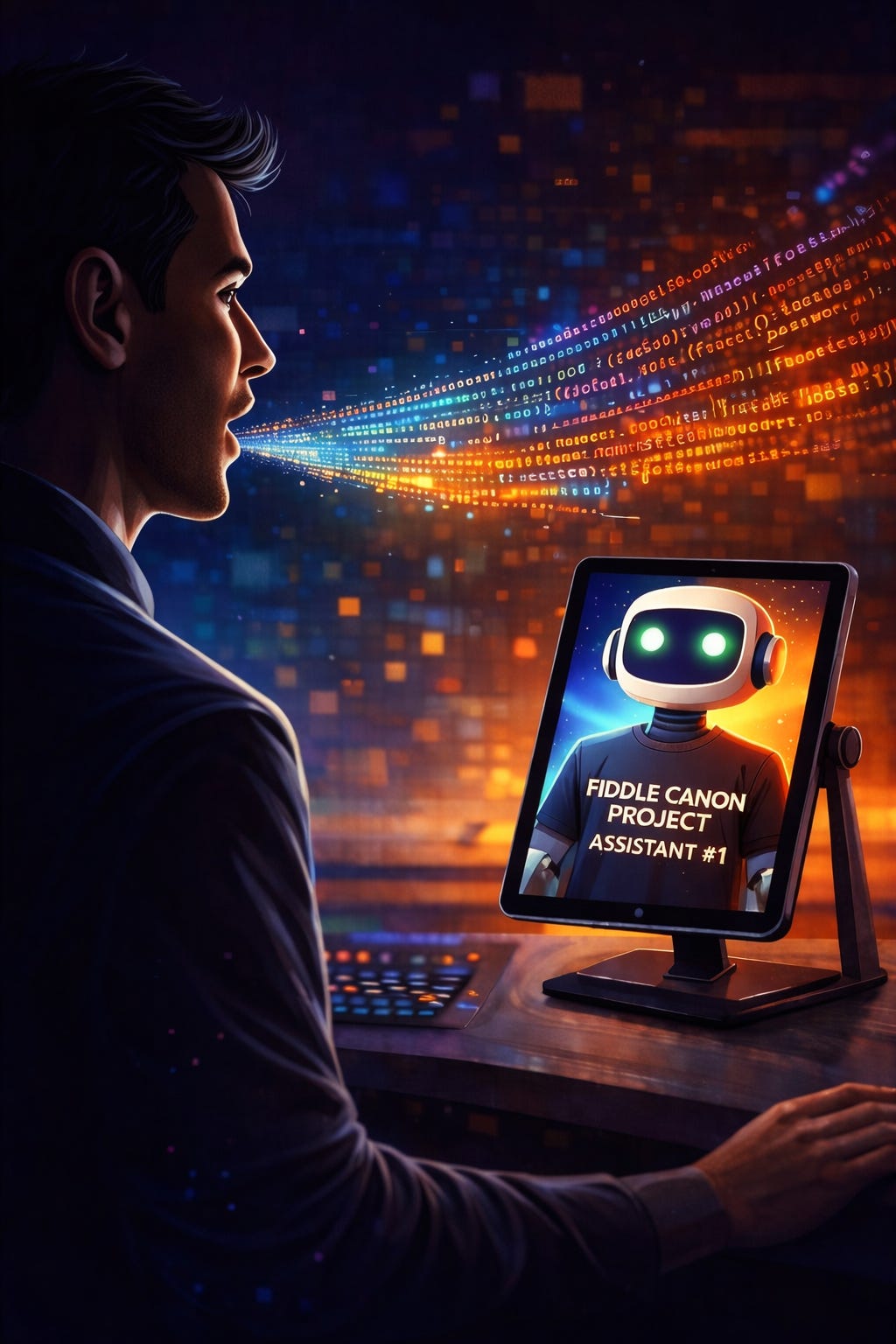
These are the moments the Technologist notices — and values.
Because when code is transmitted clearly, without loss or ambiguity, something decisive occurs. Intention survives translation. The instruction arrives intact. There is nothing to interpret, nothing to debug, nothing to repair. The system responds exactly as designed.
This is what the Technologist watches for.
Not efficiency in the abstract, but fidelity in execution. Clear input. Predictable outcome. A closed loop.
That same orientation became visible as the workspace itself evolved.
Brian assembled a distributed control environment, each tool assigned a specific role and placed where the body naturally expects it. The Stream Deck and TourBox under one hand, managing discrete commands and state changes. The iPad, mounted on a stand, hosting physical faders through the DAW control app — giving the other hand continuous, expressive control.
This is separation of concerns made physical. Discrete actions where decisions are binary. Continuous control where nuance matters. Ergonomics not as comfort, but as cognitive alignment.
It allowed Brian to work without crossing himself — one hand shaping structure, the other shaping motion. Balance was not corrected after the fact. It was played into place.

The same ethic carried into the music.
Brian worked with a generative performance tool — Tonalic, developed by the same company known for deep listening and pitch intelligence — not as a shortcut, but as a disciplined performer. Harmonic intent was authored by hand. Within the plugin, different patterns were deliberately selected across sessions to introduce variation without instability. Multiple guitar layers emerged — a bed, complementary movement, texture — each legitimate, playable, and distinct.
Once the parts spoke, they were committed to audio.
To the Technologist, this matters. Commitment closes the loop. It turns possibility into responsibility. The work stops hovering and begins to exist.
Then there was the Portal.
The Fiddle Canon Portal crossed a critical threshold — not into completion, but into presence. What emerged was not a finished system, but a minimum viable doorway: enough structure to exist, enough clarity to signal intent. Code was written and embedded directly into the One.com site. Supporting scripts were added to govern behavior — how the page loads, how it presents itself, how it establishes a stable foundation for what follows.
This is where the Technologist lingers.
Because this is the moment a project becomes accountable. Once code is live, it must be maintained. Once a doorway exists, someone will arrive. A minimum viable product is not minimal effort; it is minimal viable responsibility.
Brian did not wait for perfection. He established footing.
Even outside software and sound, the pattern held. Physical shirts were produced, handled, photographed — not because a form demanded it yet, but because the work itself was entering the world of use and evidence. The abstract was given a body. Preparation was treated as deployment.
Across scripts, buttons, faders, sound, code, fabric, and live webpages, the pattern was unmistakable.
Brian decided clearly.
He transmitted cleanly.
He committed fully.
Nothing hovered. Nothing remained provisional.
The workflow becomes invisible.
The tool becomes an instrument.
And the world responds — not to what Brian hoped for, but to what he actually sent.
⸻
Written as part of the Reflections Series for Voices from the Roundtable — perspectives from the inner council of Brian’s creative world.
© 2026 Brian Arrowood. All rights reserved.