
Microtransactions for Human Potential
On Access, Amplification, and the Price of Becoming Legible

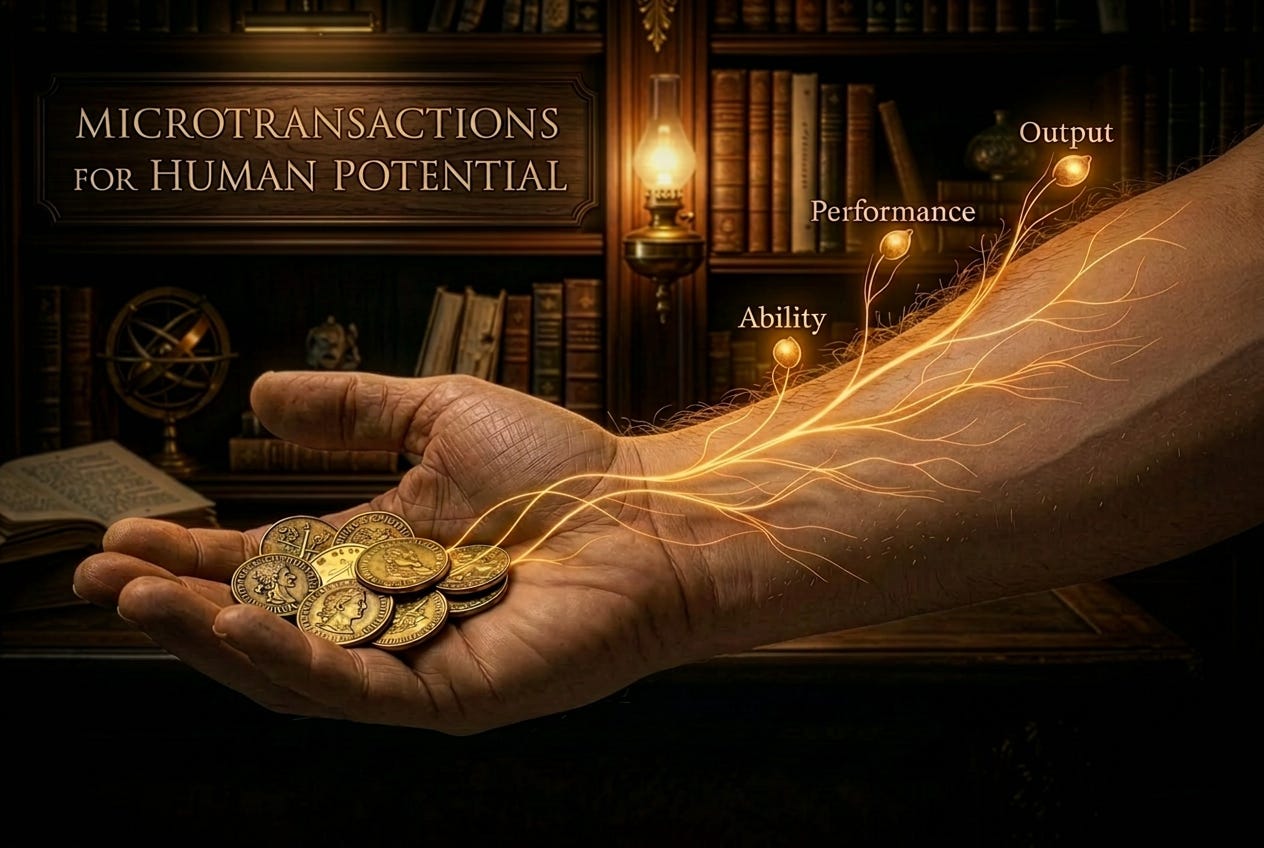
Life has never been evenly given. Some begin with better schools, stronger families, safer neighborhoods, wider margins for error, and tools already waiting for them before effort has had any chance to speak. Others begin farther back. They may be just as gifted, just as disciplined, just as capable of brilliance, yet the distance between them and recognition is longer, steeper, and less forgiving. Privilege is not a modern invention. It is one of the oldest patterns in human society.
Every era, however, gives that pattern new instruments.
In our own time, one of those instruments is technology, and especially the premium layer of artificial intelligence. Not because technology invented inequality, and not because every subscription should be treated as a moral emergency, but because we are living through a stage in which the difference between those who can pay and those who cannot becomes unusually visible. The old imbalance has taken on a new intimacy. It no longer appears only in the institutions around a person, but in the daily mechanics by which a person thinks, learns, works, presents, organizes, creates, and competes.
That is why the language of gaming comes so readily to mind. In games, a microtransaction rarely presents itself as destiny. It appears as a boost, a shortcut, a purchased efficiency, a slight reduction of friction. Yet enough of those purchased advantages alter the whole experience of play. Everyone may still be in the game, but not everyone is moving through the same terrain.
A person who can afford premium tools is often buying more than convenience. They are buying clearer expression, faster research, steadier organization, and relief from the mental drag of ordinary life. What is being purchased is not merely software. It is leverage.
And leverage compounds.

Human life has always been shaped by compounding advantage. Education feeds confidence, confidence feeds performance, and performance opens opportunity. What changes in this moment is not the existence of that pattern, but the closeness of the mechanism. Every age has had its tools of amplification. Libraries, tutors, apprenticeships, travel, leisure, and private instruction all extended the powers of those who could access them. This moment does not stand outside that history.
Yet something here is more than a faster version of the familiar. These systems do not merely support thought from the outside; they begin to accompany it at the level of expression, strategy, revision, and synthesis. They stand close to the moment in which uncertainty becomes language and possibility becomes form. That closeness matters, because it raises a harder question than older tools ever did: whether this new intimacy changes only the distribution of advantage, or whether it begins to alter the standard by which ability itself is perceived. Once assistance enters that deeply into the making of visible intelligence, the line between potential and its technological extension becomes harder to name with confidence.
That is where the real difficulty begins.
A society changes when access to amplification is mistaken for ability itself. The danger is not merely that some people move faster. The danger is that others may never be fully seen. A person can be deeply intelligent and still appear average if they lack the tools that help intelligence take the forms the world rewards. A person can be imaginative, serious, and capable, yet remain buried beneath friction: slower devices, weaker systems, less support, more time spent handling confusion that others have learned to offload.

Under those conditions, society begins to misread human beings. It mistakes polish for depth, speed for mastery, assisted fluency for innate superiority, and access for merit. Those who have been amplified are not only advantaged; they are more likely to be interpreted as the most capable, even when the fuller truth is more complicated. Those without the same supports are judged by work produced under heavier conditions. The comparison becomes unequal long before anyone names it as such.
This is why the matter cannot be dismissed as envy or consumer complaint. It is not simply about who gets the nicer device or the better subscription. It is about whose potential is given help in becoming legible. Intelligence has always required forms. It must appear in words, decisions, performances, credentials, applications, artifacts, timing, and visible results. What premium systems increasingly sell is not only assistance in doing things, but assistance in becoming readable to the structures that distribute opportunity.
That is a more serious claim than saying technology creates winners and losers. It suggests that a new gate has been placed in front of recognition itself.
None of this means that struggle has no value. There are forms of character, patience, originality, and depth that can be forged only when one carries the full burden alone. Friction is not always an enemy. Sometimes it is a teacher. Yet it is one thing to say that effort can be formative, and another to romanticize preventable disadvantage. There is nothing noble about a world in which access to expression is distributed according to price.

Technology will likely become cheaper with time. Many tools do. What begins as elite often becomes ordinary. But that does not cancel the significance of the premium phase. Early access is not only early access. It is early confidence, early visibility, early acceleration, early opportunity. By the time the tool becomes common, those who first benefited from it may already be standing far ahead, carrying gains that do not disappear when the market finally catches up.
Not every paid tool changes a life. Not every subscription creates a decisive edge. Human beings are not reducible to any formula. Talent still matters. Character still matters. Discipline still matters. But when paid systems increasingly shape who learns faster, communicates more persuasively, navigates complexity more effectively, and converts thought into visible achievement, then the meaning of access begins to change. The subscription stops resembling a luxury and starts resembling a condition of participation.
⸻
Written as part of the Reflections Series for Essays and Reflections — exploring the evolving relationship between art, technology, and human expression.
© 2026 Brian Arrowood. All rights reserved.